|
To have electricity has far deeper implications than just having light in their house. A whole range of issues are influenced through it. It enables people to learn to read and write (for example through the RIDS-Nepal Non Formal Adult and Children Literacy Program). It also takes care of a big Health Problem. The burning of highly smoky pine wood for light has been major cause for respiratory illnesses. Light also improves the social activities among the people. All these are parts of a Healthy Development RIDS-Nepal wants to perceive for the upraising of people's living conditions.
Renewable Energies, and the appropriate use of them for such poor and remote mountain communities we live with, is a real challenge. In many countries these days Governments support projects and program which are path leading in the appropriate use of renewable natural energy resources such as wind, sun and water for the production of electricity. RIDS-Nepal too has been active since 1997 in this field.
Where we live, in the midst of the Himalayas between 2300 - 4000 meter above sea level (7000 - 13000 feet), with its deep valleys, we have strong winds during the day. Data gathered by meteorologists confirm that with all the wind 'available' here, it is possible to produce electricity for 5 to 6 hours per day during at least 7 months a year.
This figures were enough to take up the challenge for a trial. In spring 1999 the first hand made wind generator was erected. As second pole with the double height was put in place in spring 2000. Though the place where the wind generator is installed is not ideal from the wind speed point of view, it is mainly a test phase for the next prototype. To keep costs as low as possible, to make it affordable, to design it appropriate for sustainability and not for maximum output, are some of the key issues we want to focus in the evaluation and development of the wind generator. We aim that the local people will be able to construct such Wind Generators themselves out of local wood and readily available generators in the years to come. All these new skills will be part of RIDS-Nepal's skill training programme in the years ahead.
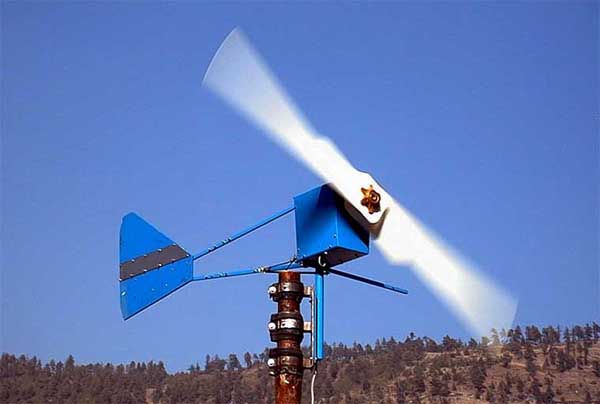
Here some technicalities, pictures and information of the first test Wind Generator installed in Jumla
|
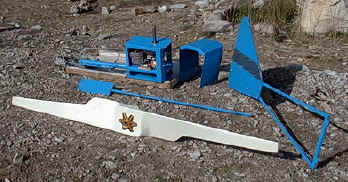
All the parts to set up the Wind Generator: A 2 blade wooden impeller with 2.05 m diameter, car alternator with 1:4 gear box, condensers, diodes and pole fixation, big wind direction flag (to keep the impeller always towards the wind direction), emergency wind flag (to turn the impeller out of the wind over approx. 35 m/s wind speed), and the generator cover |
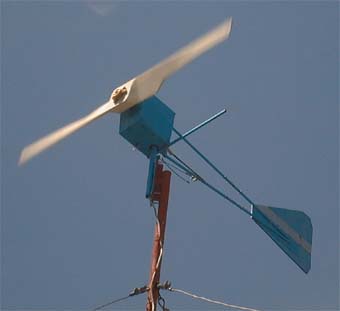
Finishing installation and setting up the steel (12 meter high) to which the wind generator is fixed
|
|
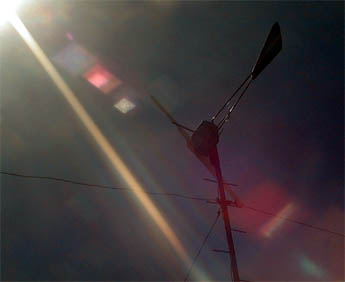
In an angle of 120 degree, the first in 6m and the second in 10m height each three iron wires are holding the steel pole secure |
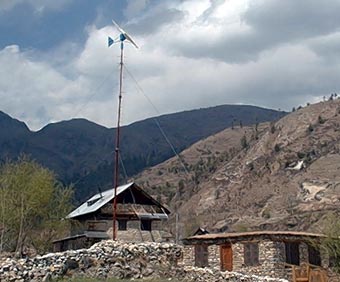
From approx. 300 Rpm onwards the Wind Generator provides 12 Volt |
|
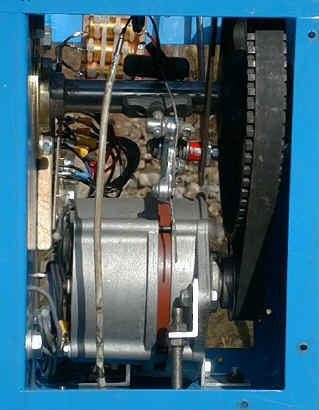
The inside of the Wind Generator: Bosch K1 14 Volt 35 Amps car alternator, belt set system with wheels 1: 4, emergency brake system (mountain bike brake)
|
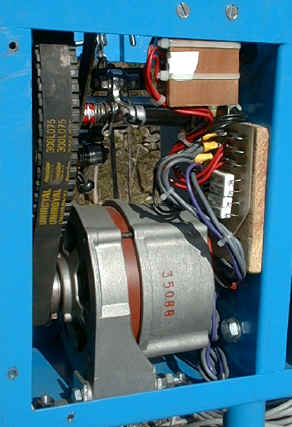
The inside of the Wind Generator: Bosch K1 14 Volt 35 Amps car alternator, 1:4 wheels with belt set system, capacitors, electronic circuit plate, brakes
|
|
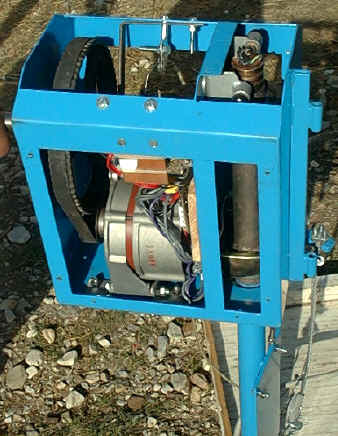
View into the Wind Generator box from top. At the right side down you can see the iron plate the Wind Generator is mounted to the pole's iron plate
|
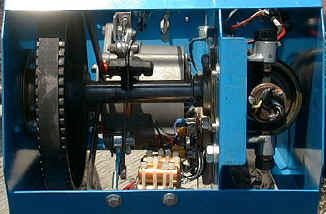
Looking into the Wind Generator from top.
Left: Gear system with belt set system ratio 1:4 ; mountain bike brakes to stop the impeller in emergency or maintenance situations; Bosch K1 14 Volt 35 Amps car alternator; 6 capacitors; electronic circuit plate. Right: The three phases connected to three coals to enable the Wind Generator to turn 360 degrees, according to the wind's direction; the three wires are led inside the iron pipe downwards to the battery charge controller |
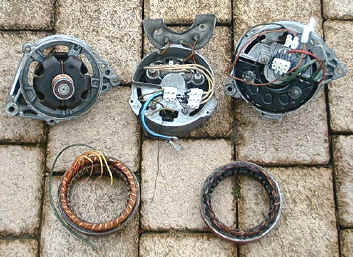 The Bosch K1 14Volt 35 Amps car alternator (from top left): 1) New, both side dust protected, bearing rolls, and new, on the lathe, reworked slip rings ; 2) New diodes and connections welded; 3) Finished new re-winded Bosch car alternator seen from the back; 4) New, three time more, re-winded Bosch alternator stator; 5) Original Bosch alternator stator The Bosch K1 14Volt 35 Amps car alternator (from top left): 1) New, both side dust protected, bearing rolls, and new, on the lathe, reworked slip rings ; 2) New diodes and connections welded; 3) Finished new re-winded Bosch car alternator seen from the back; 4) New, three time more, re-winded Bosch alternator stator; 5) Original Bosch alternator stator |
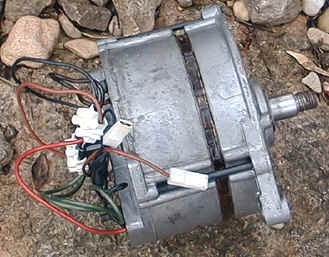 Finished new re-winded and reworked Bosch car alternator, ready to have a wooden impeller mounted DIRECT on the alternator axe, as the new rewinding (36 windings per slot with 2 x 0,57 mm diameter wire) provides by 400 Rpm its full voltage (14 volts). This makes the Wind Generator cheaper, and easier to maintain, as there is no gear system Finished new re-winded and reworked Bosch car alternator, ready to have a wooden impeller mounted DIRECT on the alternator axe, as the new rewinding (36 windings per slot with 2 x 0,57 mm diameter wire) provides by 400 Rpm its full voltage (14 volts). This makes the Wind Generator cheaper, and easier to maintain, as there is no gear system |
|
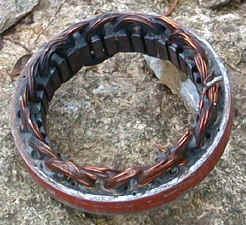
The original Bosch K1 14 Volt 35 Amps alternator stator. It has 36 slots with 12 windings each with 1,2mm wire, providing 14 volts by about 1000 Rpm
|
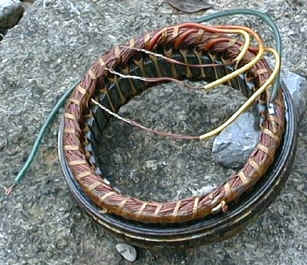
New re-winded Bosch K1 14 Volt 35 Amps stator. In its 36 slots are now 36 windings each with 2 x 0,57mm wire, providing 14 volts by ca. 400 Rpm
|
|
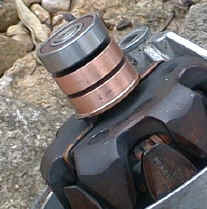
The new dust free bearing rolls (both sides) on the rotor axe, and the new, on the lathe reworked, slip rings for better connection to the coals
|
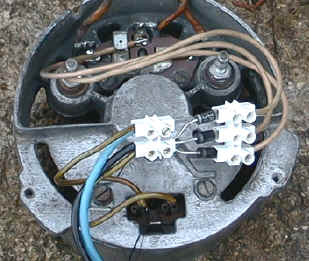
Back side of the new re-winded and reworked Bosch alternator with its different connections and the new diodes fixed
|
 |



 Solar PV Training Manual (17461)